Overview
What is a CNC Router Wood with 4th Axis?
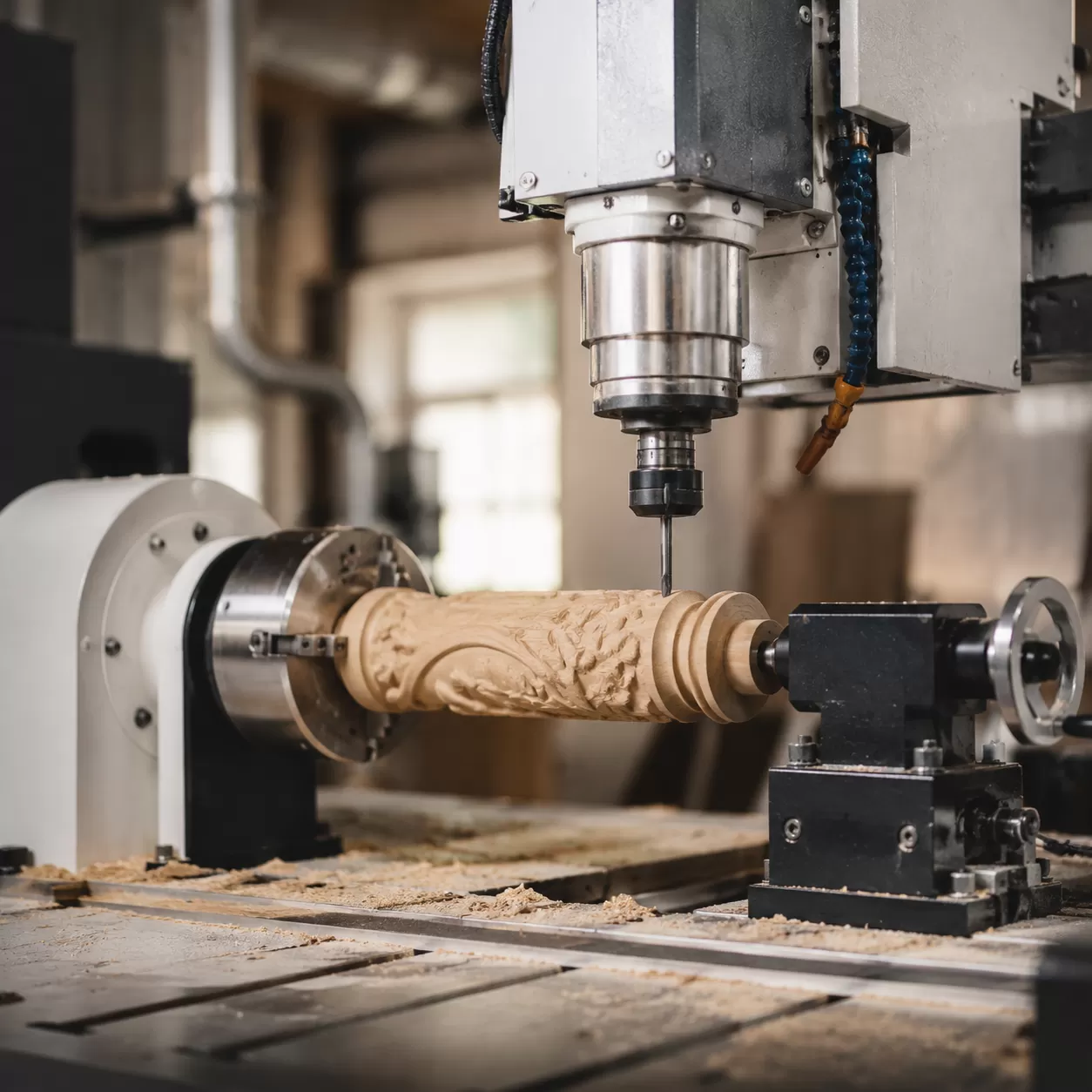
A CNC router wood with 4th axis configuration introduces a specialized rotational axis to the traditional X, Y, and Z axes. Instead of only cutting from the top down, the machine can rotate the workpiece dynamically during operation. This addition transforms a standard gantry system into a highly capable carving center designed for complex, multi-sided woodwork.
What Exactly is a Rotary Axis CNC Wood Router?
A rotary axis CNC wood router integrates a synchronized chuck and tailstock assembly directly onto or alongside the flat processing bed. Operating as the A-axis or B-axis, this system treats the wood stock as a cylinder rather than a flat sheet. The control software translates linear Y-axis movements into precise rotational degrees. This engineering allows the spindle to maintain a perfect perpendicular cutting angle relative to a curved surface, enabling true 360 degree carving without manual stock flipping.
Why Standard 3 Axis Machines Fall Short for Cylindrical Work
Standard 3-axis machines are designed specifically for sheet material machining and planar processing. When attempting complex 3D projects on a standard 3-axis setup, several production bottlenecks occur:
- Undercut Blind Spots: A standard 3-axis spindle cannot reach beneath the widest point of a curved or cylindrical workpiece, leaving raw, un-machined material.
- Constant Manual Re-clamping: Multi-sided indexing requires you to manually pause the machine, flip the wood, and re-zero the workspace, which introduces alignment errors.
- Poor Surface Finish on Slopes: Carving deep curves with flat X, Y, and Z movements forces the tool tip to step down incrementally, leaving jagged, rough edges that require extensive hand sanding.
How a 4th Axis Rotary Table Changes the Game for Your Shop
Adding a 4th axis rotary table to our machinery completely redefines what your woodworking shop can produce. It bridges the gap between flat panel routing and specialized CNC wood turning lathe machine work, offering distinct production advantages:
- Flawless 3D Cylindrical Engraving: Produce custom stair balusters, intricate table legs, columns, and custom tool handles with precise detail in a single automated setup.
- Eliminated Setup Errors: By locking the material into a secure 4 jaw chuck tailstock, the control system tracks the exact rotation angle, ensuring perfect symmetry across all faces of the wood.
- Expanded Product Catalog: Your shop can seamlessly pivot from cutting cabinet doors and nested sheet components to carving high-end, three-dimensional architectural components on the exact same machine.
Industrial-Grade Build Quality for Heavy-Duty Carving
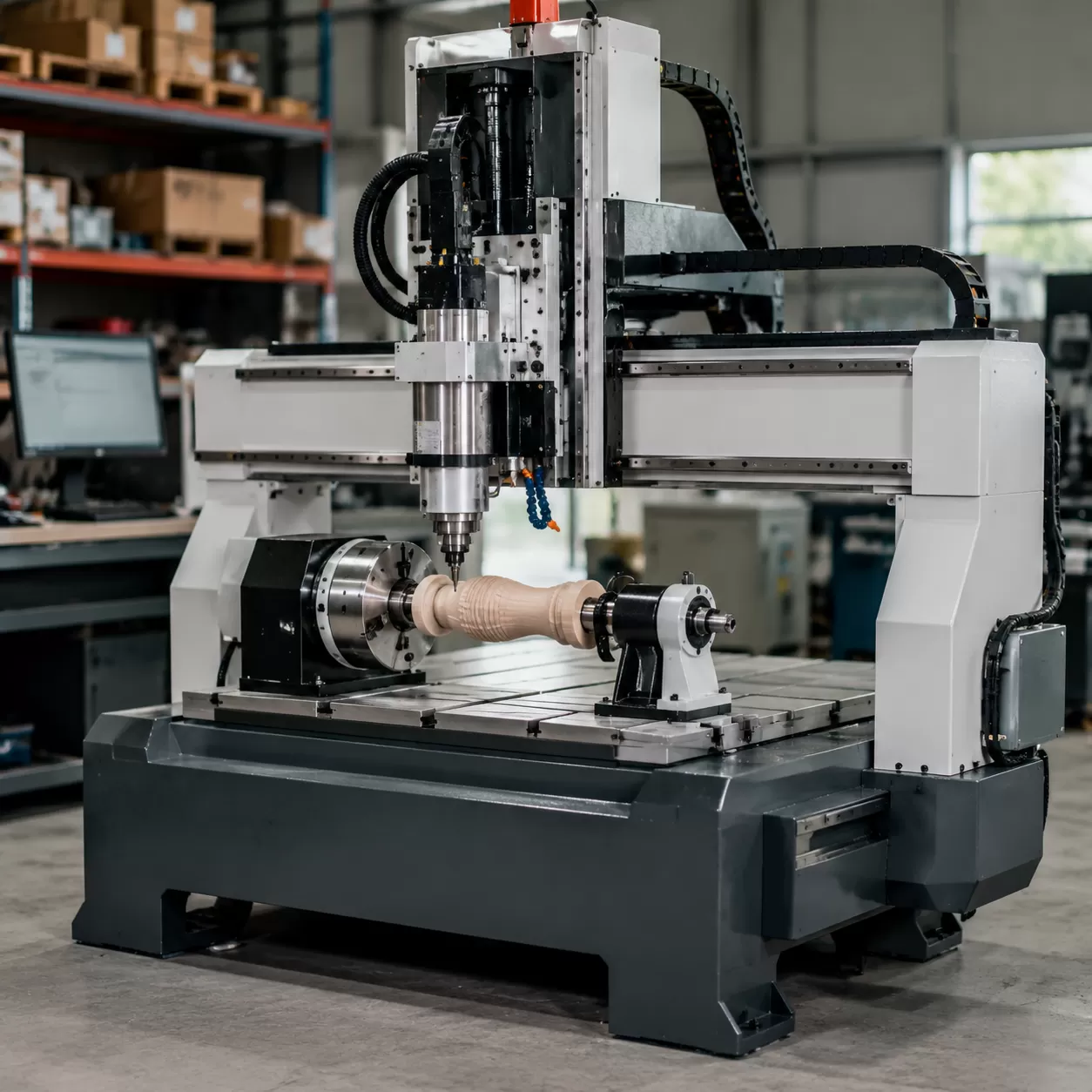
Lightweight frames simply cannot handle the rotational forces and deep carving depths required for high-end architectural millwork, custom furniture legs, or intricate columns. We engineer our machines with an unyielding foundation to ensure that your tool paths remain dead-accurate, even during aggressive material removal.
Why a Heavy-Duty Cast Iron Gantry CNC Beats Lightweight Frames
A heavy-duty cast iron gantry CNC is the backbone of a true industrial-grade machine. Unlike aluminum or thin sheet-metal gantries that flex under the structural load of a heavy-duty spindle and a spinning 4th axis rotary table, cast iron absorbs deflection. This massive rigidity eliminates the structural chatter that ruins surface finishes. By choosing a cast iron gantry, you get perfectly smooth cuts on complex 360 degree carving projects without having to sand away tool marks for hours afterward.
Stress-Relieved Steel Tube Bases That Stop Vibration Dead
The frame of our rotary axis CNC wood router starts with heavy-walled steel tubing that undergoes a strict thermal stress-relieving process. We bake the welded frames to eliminate internal structural tension before machining the guide rail seats. This prevents the frame from warping over years of hard shop use. The sheer weight of this stress-relieved base stops harmonic vibrations dead in their tracks, keeping your 3D cylindrical engraving precise to the millimeter.
To keep your workspace running smoothly alongside these heavy-duty machines, we also manufacture premium industrial components and CNC spare parts to ensure minimal downtime and long-term reliability for your shop.
Dual-Motor Synchronized Drives
Driving a wide gantry from just one side is a recipe for binding and structural twisting, especially when working on a 3 axis machine with rotary attachment where forces are unevenly distributed. We equip our machines with dual-motor synchronized drives on the Y-axis.
- Zero Crabbing: Both sides move in perfect harmony, eliminating gantry misalignment.
- High Torque Delivery: Dual motors provide the raw pushing power needed to maintain high feeding speeds.
- Extended Component Life: By preventing twisting, there is less wear and tear on your linear guide rails and transmission systems.
High-Precision Controls and Power Subsystems
When configuring a cnc router wood with 4th axis setup, the internal power subsystems determine whether your shop can handle complex architectural work or high-volume furniture manufacturing.
Helical Rack-and-Pinion vs. Ball Screws
For the X and Y axes, precision-ground helical rack-and-pinion systems are the industry standard for high-speed machining. Unlike traditional ball screws, which can whip and flex over long distances, helical racks offer continuous tooth engagement. This results in smoother acceleration, less wear, and massive force transmission. Ball screws remain the go-to choice for the Z-axis, where shorter, high-load vertical positioning requires absolute zero-backlash control.
Stepper Motor vs. Servo CNC Drive Systems
Choosing the right motor configuration directly impacts your production speed and accuracy:
| Feature | Stepper Motor Systems | Servo CNC Systems |
|---|---|---|
| Feedback Loop | Open-loop (No position verification) | Closed-loop (Constant position feedback) |
| Speed & Torque | High torque at low speeds; drops off | Maintains high torque at high RPMs |
| Precision | Excellent for standard carving | Micro-precise; eliminates lost steps |
| Best Used For | Budget-conscious shops, entry-level 3D | High-speed industrial production |
For shops utilizing a furniture CNC router to produce detailed chair legs or crown molding, upgrading to closed-loop servos ensures the machine never loses its place during complex 360-degree rotary paths.
Premium Square Linear Guide Rails
To maintain a uniform load capacity across all axes, we utilize premium heavy-duty square linear guide rails. These rails feature four rows of ball bearings that distribute weight evenly, whether the gantry is accelerating down a flat sheet or handling the intense torsional forces of a heavy hardwood log spinning on the 4th axis rotary table. This rigidity ensures chatter-free finishes that require zero manual sanding.
Inside the 4th Axis Rotary Indexer Mechanics
How the Self-Centering 4 Jaw Chuck Tailstock Keeps Wood Locked Down
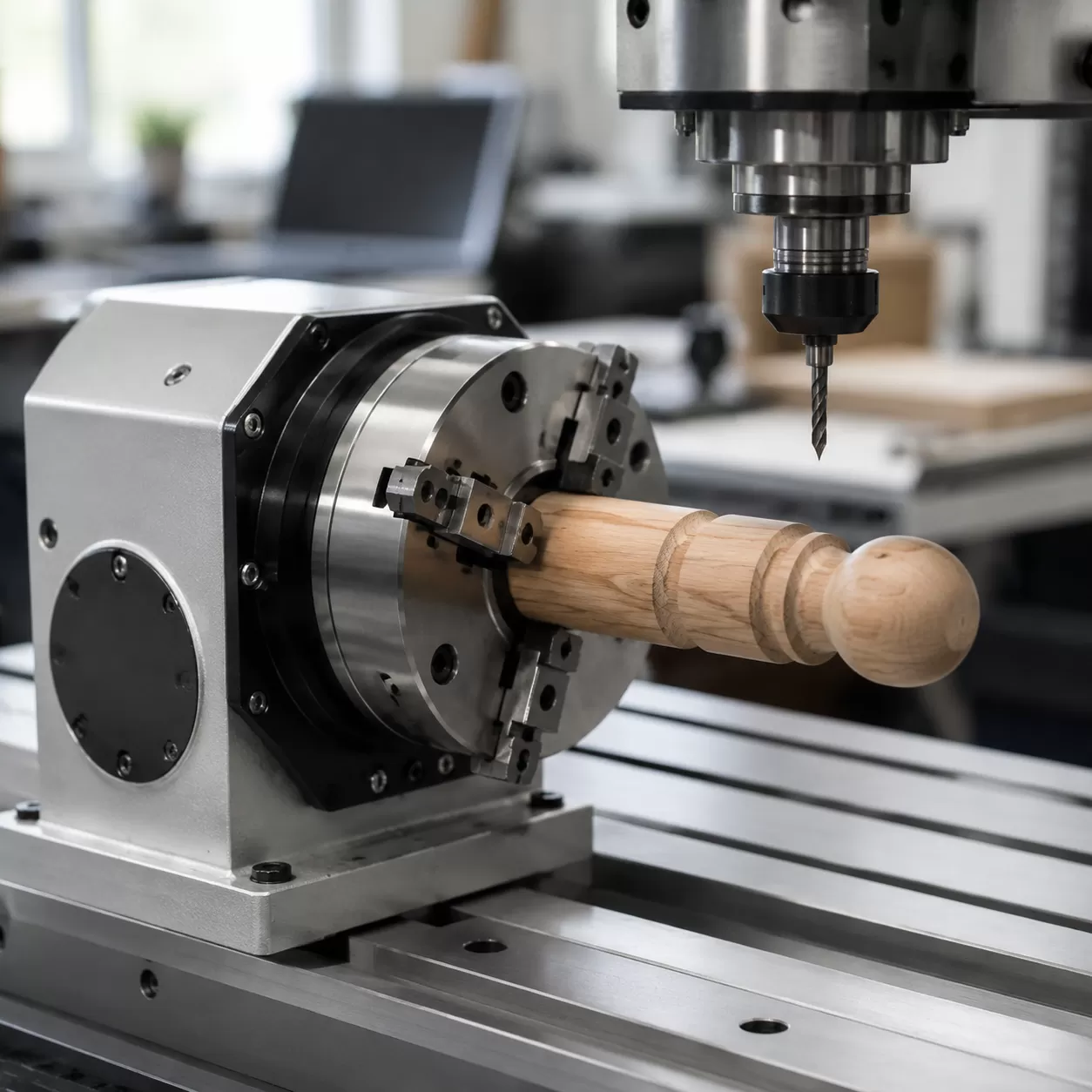
When executing complex 360 degree carving projects, workpiece stability is non-negotiable. Our rotary axis CNC wood router systems employ a heavy-duty, self-centering 4 jaw chuck tailstock configuration to secure stock. Unlike standard 3-jaw systems that can struggle with square timber or irregular wood blanks, the 4-jaw design applies independent, uniform clamping force across four contact points.
[4-Jaw Chuck] → Clamped Timber Stock →[Adjustable Tailstock]
The adjustable tailstock moves smoothly along the guide rails, allowing you to lock down varying lengths of wood with zero axial play. This rigid clamping mechanical structure ensures that the workpiece remains perfectly concentric throughout the entire machining cycle, eliminating slippage even during high-speed rotational carving.
Planetary Gear Reducers and Why Holding Torque Matters for Deep Cuts
The true capabilities of a CNC router wood with 4th axis depend heavily on its drive reduction system. We equip our rotary units with high-precision planetary gear reducers rather than cheap belt drives.
- Elimination of Backlash: Planetary gears ensure near-zero backlash, translating to flawless carving transitions without ghosting or flat spots.
- Massive Holding Torque: Deep, aggressive roughing passes exert tremendous rotational forces on the wood. High holding torque stops the workpiece from deflecting under heavy spindle loads.
- Smoother Interpolation: Constant, micro-step positioning ensures the surface finish requires minimal sanding right off the machine.
| Drive Type | Backlash Control | Torque Transmission | Ideal Application |
|---|---|---|---|
| Planetary Gear Reducer | Excellent (Near-Zero) | High / Consistent | Heavy 3D Cylindrical Engraving |
| Standard Belt Drive | Poor (Prone to stretch) | Low / Slips under load | Light duty hobby work |
Table-Top Units vs Recessed Drop-Bed Frame Configurations
Choosing how the rotary axis integrates into the machine geometry directly impacts your daily shop workflow and the size of materials you can handle.
For shops focused primarily on standard flat work that occasionally need a 3 axis machine with rotary attachment, a table-top unit offers great flexibility. It mounts directly onto our 3-axis CNC wood router beds using T-slot clamps and can be unplugged when you need to clear the deck for large panel processing.
However, if your production demands frequent switching between sheet material machining and thick column turning, our recessed drop-bed frame configuration is the industrial answer. By sinking the rotary axis into a dedicated channel alongside or below the main table surface, you gain massive swing diameter clearance. This allows you to carve thick architectural pillars and heavy table legs without sacrificing valuable Z-axis gantry height.
Spindle Power and Cooling Systems
The spindle is the heart of your rotary axis CNC wood router. Choosing the right power rating and cooling method directly dictates your cutting speed, edge quality, and the types of materials your shop can efficiently process.
Choosing Your Industrial Spindle Size (2.2kW to 9.0kW)
Matching your spindle power to your production volume prevents motor stalling and ensures clean 360 degree carving results.
- 2.2kW to 3.5kW Spindles: Ideal for mid-duty shops focusing on detailed 3D cylindrical engraving, intricate furniture legs, and standard hardwood processing.
- 4.5kW to 6.0kW Spindles: The sweet spot for high-production environments. These systems handle rapid material removal on large-diameter timber without breaking a sweat.
- 9.0kW Spindles: Engineered for heavy-duty industrial scaling, heavy tooling setups, and integration with an automatic tool changer rotary CNC configuration.
Water-Cooled vs. Air-Cooled Setups
Keeping your spindle cool during long, continuous cutting paths is critical for protecting the internal bearings.
| Cooling Type | Best For | Key Advantage | Maintenance Needs |
|---|---|---|---|
| Water-Cooled | Quiet shops & deep, slow 4th axis carving | Extremely quiet operation; independent of ambient shop temperature | Requires distilled water management and antifreeze in cold climates |
| Air-Cooled | Dusty environments & rapid-cycle production | Low maintenance; plug-and-play setup that cannot leak | Louder operation; cooling efficiency depends on room temperature |
Variable Speed Controls Up to 24,000 RPM
Our systems utilize advanced Variable Frequency Drives (VFDs) to deliver precise speed adjustments up to 24,000 RPM. This flexibility allows you to tune your cutting parameters perfectly:
- High Speeds (18,000 - 24,000 RPM): Delivers flawless surface finishes on softwoods, acrylics, and composite materials, eliminating the need for manual sanding.
- Low Speeds & High Torque: Crucial when clearing heavy waste material on dense hardwoods using large-diameter bits on the 4 jaw chuck tailstock assembly.
Control Systems and CAD/CAM Software Setup
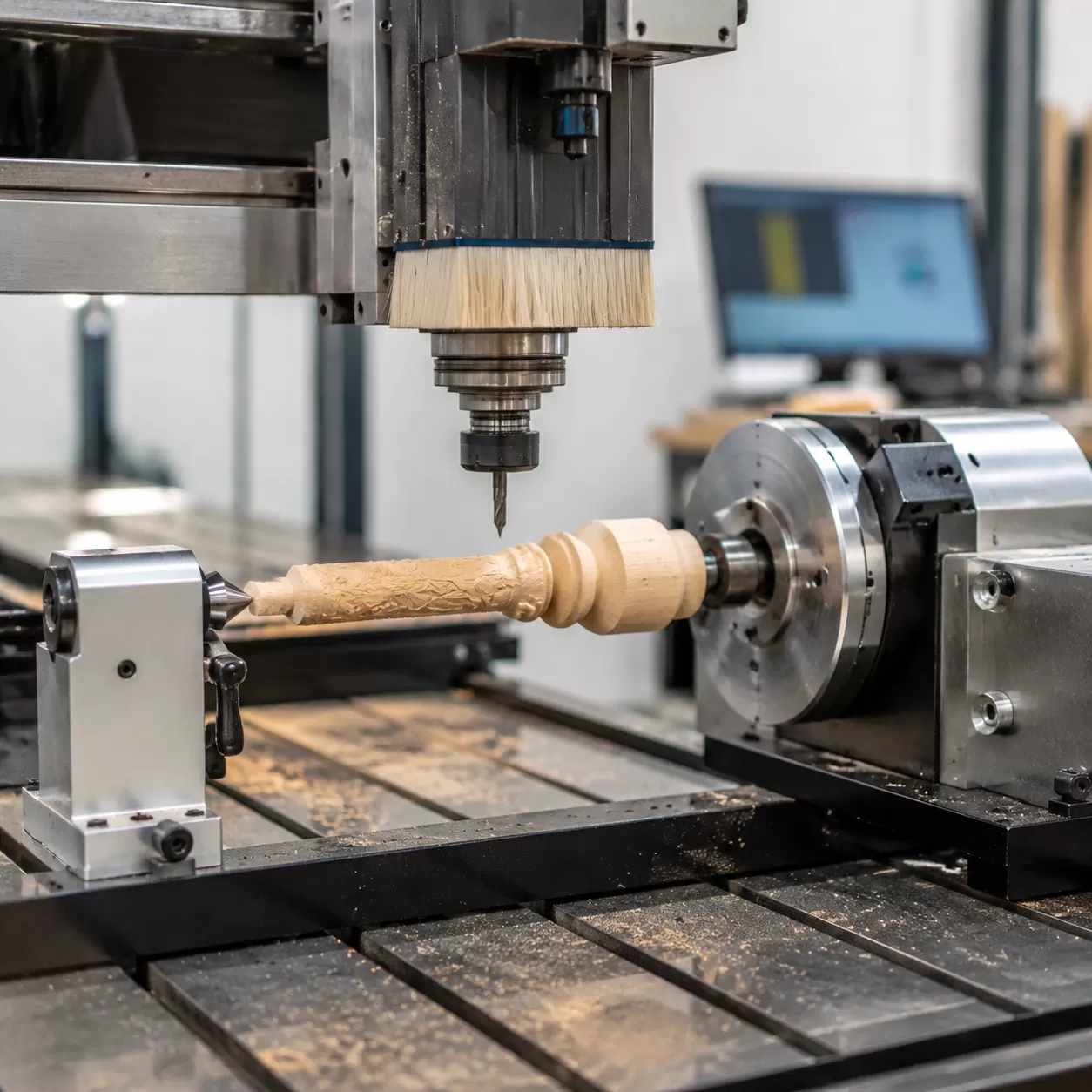
Choosing the right brain for your rotary axis CNC wood router dictates how smoothly your shop runs. We equip our machines with control options that balance ease of use with deep technical capability, ensuring you spend less time troubleshooting and more time cutting.
DSP Handheld Pendants vs. PC-Based Control Architectures
We offer two distinct control environments depending on your workflow and workshop space:
- DSP Handheld Pendants: Perfect for standalone operation. These rugged, mobile controllers let you run jobs directly from a USB flash drive. You do not need a dedicated computer next to the machine, keeping your PC safe from flying wood dust.
- PC-Based Control Architectures (like Mach4 or NC Studio): Ideal for complex 360 degree carving jobs. This setup utilizes a dedicated computer screen to display real-time toolpaths, large file visualization, and advanced editing features directly from the shop floor.
Setting Tool Zeros with an Automatic Tool Touch-Off Sensor
Manually zeroing the Z-axis on a curved surface or a shifting rotary workpiece is a recipe for error. Our system includes a highly precise automatic tool touch-off sensor.
How it works: With a single command, the tool lowers to touch the localized sensor, automatically calibrating the exact tool length in the controller. This guarantees flawless depth consistency every time you change bits during complex multi-tool carves.
Software Compatibility and Post-Processors
Our cnc router wood with 4th axis configurations integrate seamlessly with the industry-standard design software you already know and use. We provide fully optimized, reliable post-processors for:
| Software | Best Used For | 4th Axis Mode |
|---|---|---|
| VCarve Pro | Rotary wrapping, texturing, and fluting | Wrapped Rotary / Indexing |
| Vectric Aspire | Complex 3D relief carving and organic models | Full Continuous 4th Axis |
| Autodesk Fusion 360 | Advanced multi-axis toolpaths and mechanical parts | Simultaneous 4-Axis Milling |
This universal compatibility eliminates software communication headaches, letting you transition smoothly from design file to final wood product.
Technical Specifications and Structural Configurations
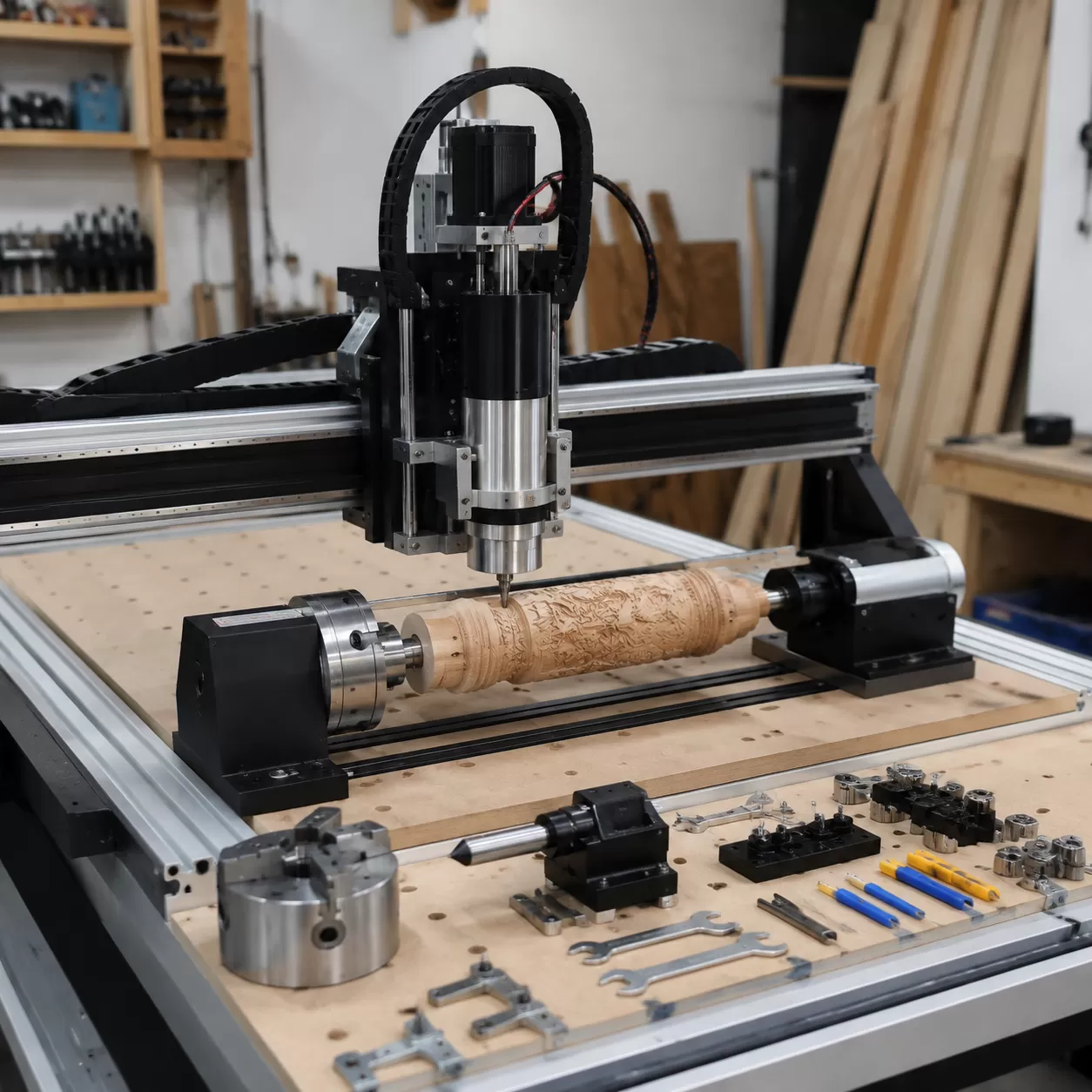
When investing in a CNC router wood with 4th axis setup, matching machine physics to your production goals is critical. The structural layout determines whether you can smoothly transition from flat panels to complex 3D rotary carving.
Sheet Material Machining Sizes vs. Rotary Swing Diameters
Our machines are built to handle both flat stock and cylindrical workpieces without compromising stability. While the flat bed handles standard sheet material machining, the 4th axis capacity is defined by its swing diameter and maximum length.
| Configuration Type | Standard Sheet Capacity | Max Rotary Swing Diameter | Max Rotary Length |
|---|---|---|---|
| Standard Flatbed + Side Rotary | 4' × 8' (1300 × 2500 mm) | 8 in (200 mm) | 98 in (2500 mm) |
| Recessed Drop-Bed Frame | 5' × 10' (1500 × 3000 mm) | 12 in (300 mm) | 118 in (3000 mm) |
| Heavy-Duty Industrial | Custom Size | Up to 19 in (500 mm) | Custom, up to 236 in (6000 mm) |
Positioning Accuracy and Maximum Feeding Speeds
We configure our industrial frames with premium components to ensure tight tolerances even during high-speed, continuous 360-degree carving.
- Positioning Accuracy: 0.03 mm over the entire travel range.
- Repositioning Precision: ±0.02 mm, ensuring multi-tool jobs line up perfectly.
- Max Rapid Travel Speed: Up to 45,000 mm/min, to cut down on non-cutting cycle times.
- Max Working Feed Rate: Up to 25,000 mm/min depending on material hardness and tooling selection.
Standard Package Accessories
Every rotary axis CNC wood router we ship comes equipped with the essential support systems needed to maintain the machinery and keep the shop floor clean.
- Centralized Oil Lubrication: A single-point manual or automatic lubrication pump delivers oil directly to all linear guide rails and ball screws, preventing premature wear.
- Dust Extraction Hoods: High-volume dust hoods ride with the spindle, capturing wood chips directly at the cutting source before they can settle into the mechanical drives.
For operations looking to expand their manufacturing capabilities beyond woodworking, we also build high-performance CNC milling machines engineered for precision metal and mold-making applications.
FAQs About 4th Axis CNC Routers
Can a benchtop CNC router with rotary indexer handle hardwoods?
A well-built benchtop CNC router with rotary indexer can absolutely carve hardwoods like oak, cherry, maple, and walnut. The secret doesn't just lie in the machine size, but in the rigidity of the setup and the spindle power. When doing 3D cylindrical engraving on tough wood grains, you need a high-torque spindle and slow, steady feed rates to prevent deflection. Using the right tooling is also critical; solid carbide ball nose or V-bit routers are ideal for leaving a clean finish on dense wood fibers without burning the material.
What is the difference between a dividing head indexer and continuous 4th axis carving?
The difference comes down to how the rotary axis moves in relation to the other axes:
- Dividing Head Indexer (3+1 Axis): The rotary axis acts as an indexer. It rotates the wooden workpiece to a specific angle (like 45 or 90 degrees) and locks it into place. The machine then executes a standard 3-axis cut. The 4th axis does not move while the cutting tool is engaged.
- Continuous 4th Axis Carving (True 4th Axis): The rotary axis rotates continuously at the same time the X, Y, and Z axes are moving. This simultaneous movement allows the machine to carve complex, flowing organic shapes, intricate spirals, and detailed custom table legs where the cutting depth changes dynamically as the part spins.
How hard is it to switch from sheet material machining to 3D cylindrical engraving?
Switching your workflow from flat sheet material machining to 3D rotary carving is straightforward once the hardware is dialed in. If you run a table-top unit or a recessed drop-bed frame, you simply mount the 4 jaw chuck tailstock assembly onto the bed or into the dedicated slot, plug in the rotary signal cable, and change your post-processor settings in your CAM software.
The biggest learning curve is setting your new Z-axis zero point, which shifts from the top of a flat board to the exact center line of your rotary axis. Utilizing an automatic tool touch-off sensor cuts this setup time down to just a few minutes, making it highly efficient to jump back and forth between flat cabinet work and full 360-degree carving.