What should fabrication shops evaluate when choosing best cnc router stone industry equipment? Frame mass, slurry shielding, and low-RPM spindle torque—not wood-router speed specs. Below: stone-grade engineering, ATC/1325/double-head/6090 configurations, granite and quartz material limits, ProMach lineup benchmarks, and factory-direct procurement for monument shops and countertop lines.
Best CNC Router Stone Industry: Core Engineering Benchmarks
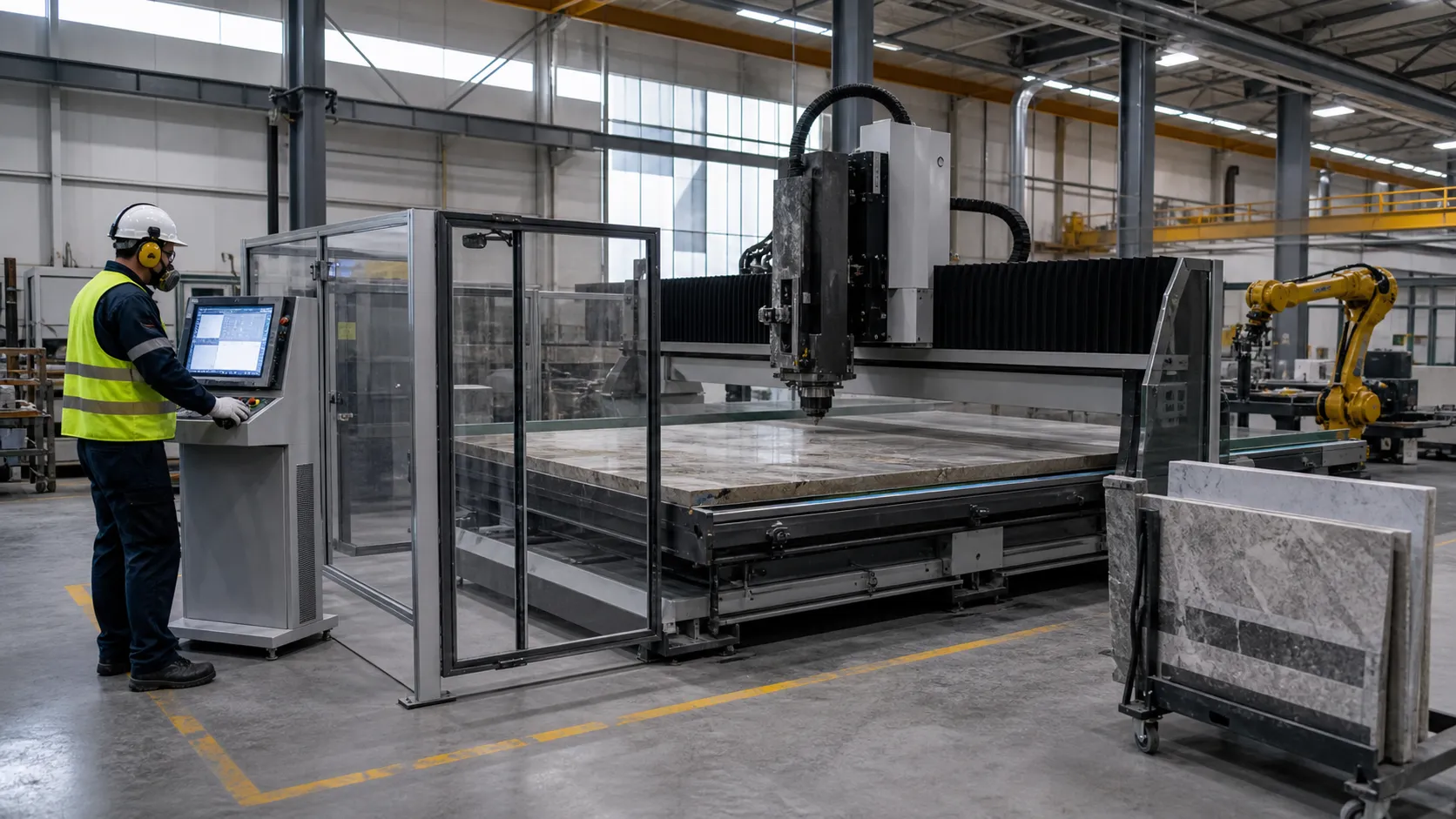
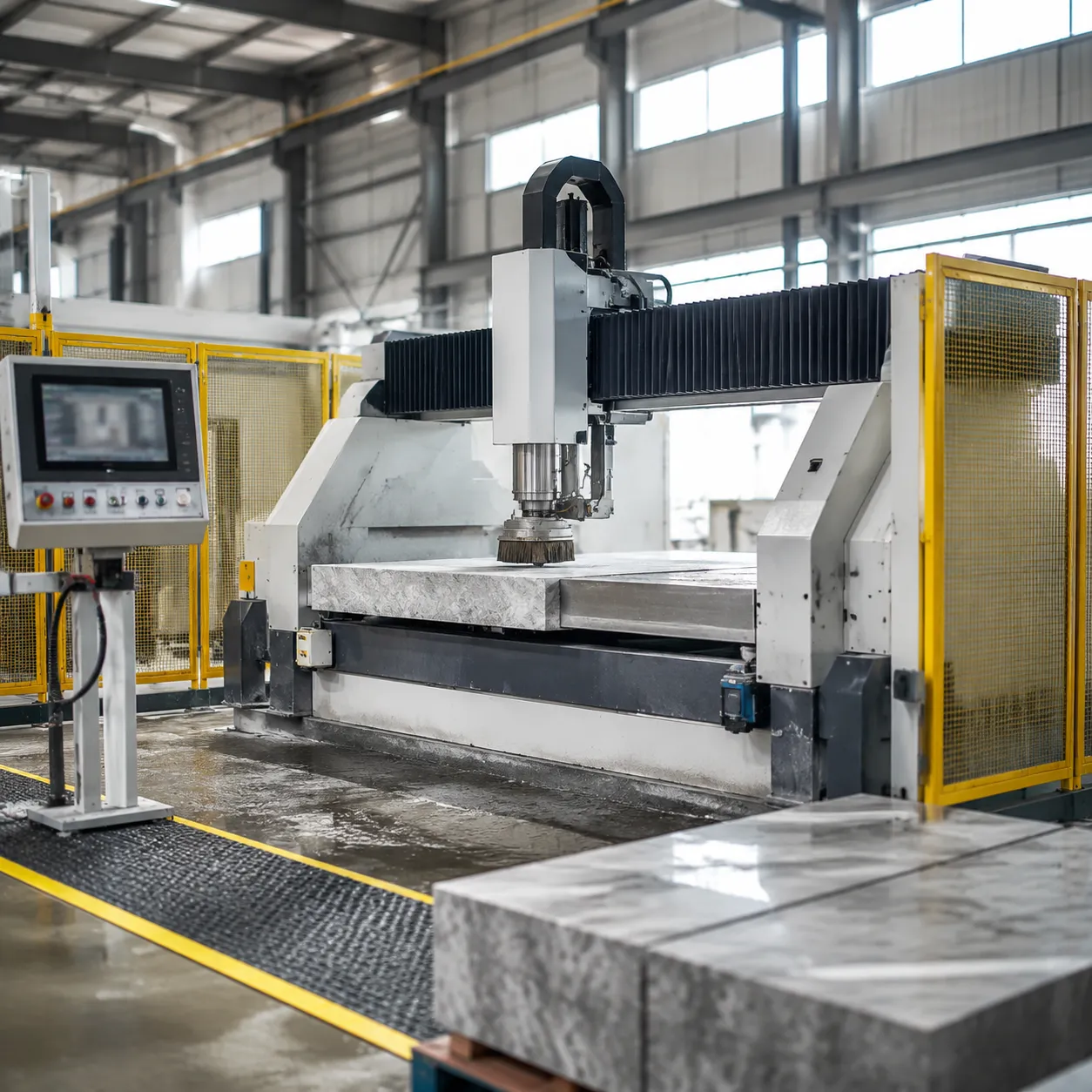
Cutting through granite, quartz, and marble requires more than just a standard machine with an upgraded motor. To find the best cnc router stone industry professionals can rely on, you have to look directly at the underlying engineering—our guide to cutting stone on a CNC router covers why torque and flood cooling matter before you compare configurations. Standard wood or soft-metal routers will quickly fail under the intense stress of stone fabrication. True stone-grade machinery is built from the ground up to handle extreme resistance, abrasive dust, and constant water force.
Structural Mass vs. Spindle Deflection
When processing heavy slabs, vibration is your worst enemy. Without massive structural weight, the force of the bit hitting hard material causes minor bending, known as spindle deflection.
- Heavy-Duty Cast Iron Frame: Our machines utilize a thick, stress-relieved steel and cast iron gantry setup to absorb cutting vibrations completely.
- Zero Deflection: High structural mass ensures the tool path stays perfectly rigid, preventing tool breakage and ensuring smooth edge polishing and precision line carving.
- High-Load Linear Guides: Industrial-grade linear rails handle the massive weight of the gantry while maintaining sub-millimeter positioning accuracy.
Environmental Shielding & Slurry Management
Stone cutting requires continuous water cooling, which creates a highly abrasive mixture of water and stone dust known as slurry. If this slurry gets into your moving parts, it acts like sandpaper, destroying bearings and rails in weeks.
- Total Slurry Protection: Our routers feature specialized stainless steel shielding and waterproof accordion bellows over all axes.
- Dust Shielding: Hermetically sealed drive components keep airborne stone particles out of the precision ball screws and linear guides.
- Advanced Drainage: A deep, integrated water tray efficiently channels runoff and stone debris away from the work area into a filtration recycling system.
Spindle Torque and Cooling Dynamics
Sinking a tool bit into engineered quartz or natural granite demands constant, high-end torque at lower RPMs compared to woodworking.
- High-Output Spindles: We equip our machinery with robust water-cooled spindles (5.5 kW – 7.5 kW) engineered specifically for continuous stone cutting.
- Thermal Control: Continuous water loop cooling prevents the spindle from overheating during long 3D relief carving cycles.
- Constant Torque Delivery: Advanced variable frequency drives (VFD) maintain high cutting force even when slowing down to handle intricate monument and tombstone details.
Best CNC Router Stone Industry: Choosing the Right Configuration for Your Workshop Scale
Finding the best CNC router stone industry operations depend on is all about matching the machine configuration to your production volume and workspace layout.
The Automated Workhorse: ATC Stone CNC Routers
For high-volume stone countertop fabrication and busy commercial shops, an ATC stone CNC router model is essential. These heavy-duty machines completely eliminate manual intervention during complex profiling, sink cutting, and edge polishing.
- Continuous Production: Seamlessly switches between rugged profiling bits and fine edge polishing tools.
- Reduced Labor Costs: Operators can prep the next slab while the machine runs its entire tool paths autonomously.
- High-Power Spindles: Typically equipped with a high-torque water-cooled spindle (5.5 kW – 7.5 kW) to plow through thick granite and quartz surfaces.
The Artistic Precision Engine: 3D Engraving & Relief Platforms (Format 1325)
The 1325 stone CNC router format is the gold standard for standard 4×8 foot sheet processing. This configuration targets monument shops, tombstone makers, and architectural millwork businesses focusing on detailed aesthetics.
- Standard Footprint: The 1300 × 2500 mm working area perfectly accommodates standard stone slabs and architectural panels.
- Artistic Versatility: Optimally tuned for intricate 3D relief carving, deep line engraving, and detailed lettering.
- Rigid Construction: Built on a heavy-duty cast iron frame to absorb micro-vibrations, ensuring clean text edges on hard headstone materials.
High-Speed Throughput: Double-Head Routers with Optional Rotary Saws
When your primary goal is maximizing daily output without expanding your shop’s physical footprint, double-head stone CNC router configurations provide the ultimate speed advantage.
- Simultaneous Processing: Dual spindles cut identical parts at the same time, doubling your throughput on mass production runs like ceramic tile or uniform building accents.
- Hybrid Efficiency: Outfitting these machines with an optional rotary saw allows for fast, straight-line stone cutting before the spindles take over for intricate detail work.
- Versatile Aggregation: Perfect for processing high-demand materials like sandstone, blue stone, and artificial stone simultaneously.
The Boutique Artisan Solution: Mini 6090 Benchtop Stone CNCs
Not every business needs a massive industrial footprint. Small-scale studios, custom jewelry makers, and boutique monument shops rely on compact mini 6090 stone CNC router setups to deliver high-margin custom work.
- Space-Saving Design: A 600 × 900 mm workspace fits easily into tight garages or smaller fabrication rooms.
- Precision Focus: Ideal for small marble engraving machine tasks, custom house signs, small plaques, and intricate tile inlays.
- Cost-Effective Entry: Delivers industrial-grade rigid stability and reliable slurry protection at a fraction of the capital investment of a full-scale bridge saw crossover or large bed system.
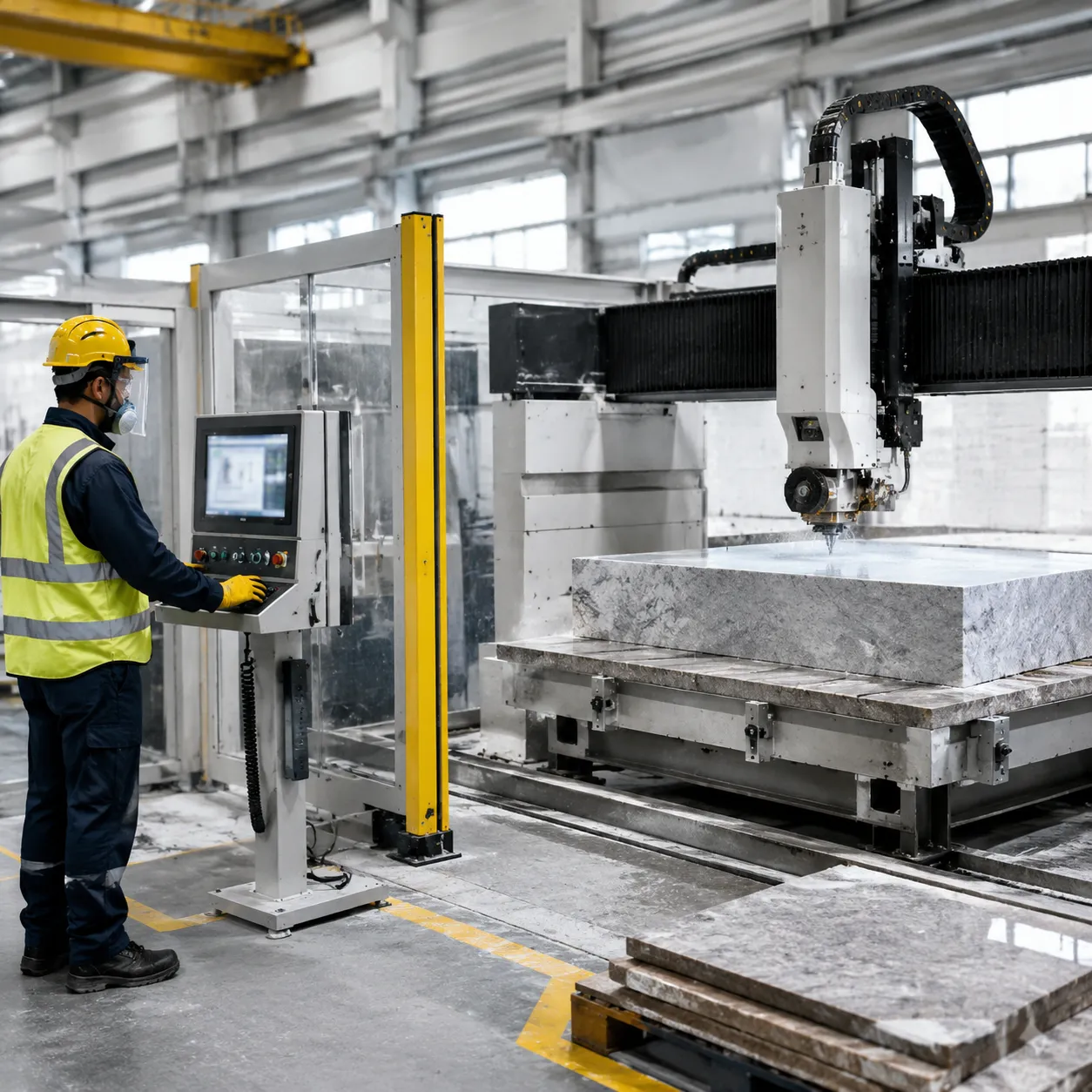
Best CNC Router Stone Industry: Materials & Applications
Choosing the best cnc router stone industry professionals rely on means finding a machine that adapts to different material densities. The hardness of your slab dictates your feed speed, tooling choice, and water flow requirements. We build our equipment to handle everything from soft decorative blocks to the most stubborn engineered surfaces.
Natural Stones: Granite, Marble, and Sandstone
Natural slabs demand rigid frame construction and high-torque spindles to prevent tool chatter and breakage.
- Granite: Highly abrasive. Requires high-pressure water cooling and heavy-duty spindles (typically 5.5 kW – 7.5 kW) to maintain deep cuts without stalling.
- Marble: Softer but prone to chipping. Perfect for intricate 3D relief carving and line engraving when paired with precise control systems.
- Sandstone & Bluestone: Soft but highly gritty. Requires robust slurry protection and dust shielding on all linear rails to prevent premature wear.
Engineered and High-Performance Surfaces: Quartz and Sintered Stone
Modern shops cannot survive on natural stone alone. High-end residential jobs demand precision handling of ultra-hard materials.
- Quartz: Highly popular for stone countertop fabrication. Demands consistent torque for clean edge polishing and cutout routing without melting the resin binders.
- Sintered Stone & Ceramic Tile: Extremely hard and brittle. Processing these ultra-compact surfaces requires absolute structural mass to eliminate micro-vibrations, preventing the slab from shattering during rapid directional changes.
| Material Type | Hardness (Mohs) | Tooling Strategy | Spindle Requirement | Primary Application |
|---|---|---|---|---|
| Marble | 3–4 | Carbide / Diamond V-Bit | Medium Torque | 3D Reliefs, Monuments |
| Granite | 6–7 | Sintered Diamond | High Torque / Water-Cooled | Countertops, Tombstones |
| Quartz | 7 | Diamond Core / Router Bits | High-Speed Constant Torque | Kitchen & Bath Vanities |
| Sintered Stone | 7–8+ | Specialized Sintered CNC Bits | Maximum Rigid Stability | Ultra-Thin Modern Facades |
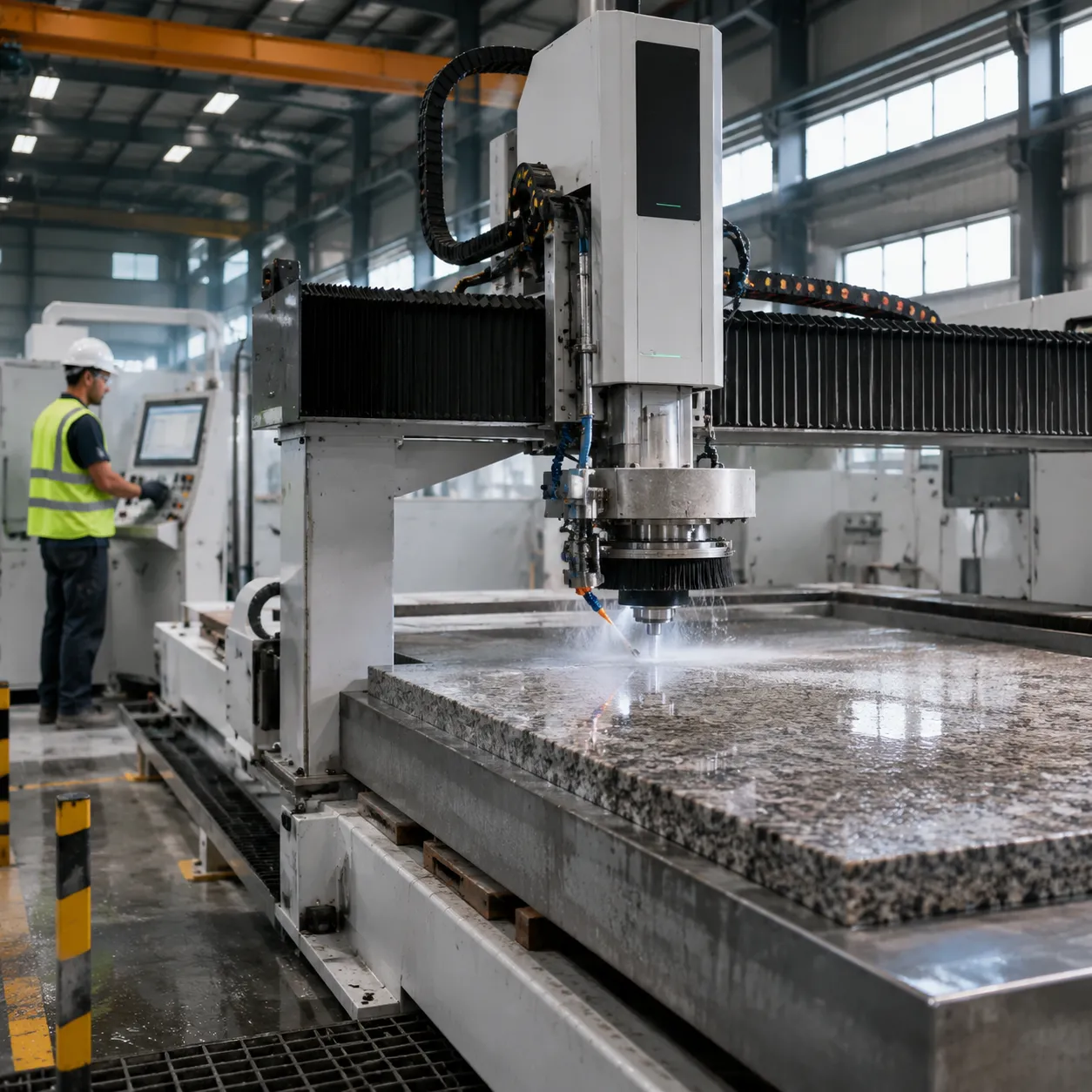
Technical Benchmark Comparison: ProMach Stone CNC Lineup
When looking for the best CNC router stone industry professionals trust, numbers don’t lie. We build our ProMach lineup to handle everything from intricate 3D relief carving to heavy-duty stone countertop fabrication.
Every shop has different throughput goals and space constraints. To help you choose the right fit for your production floor, we have mapped out the core technical specifications across our four flagship configurations.
| Machine Model | Best For | Spindle Power & Type | Workspace Dimensions | Core Control System |
|---|---|---|---|---|
| ProMach Mini 6090 | Monument shops, detailed line engraving, small tile accents | 5.5 kW Water-Cooled | 600 x 900 mm | NC-Studio / Handheld DSP |
| ProMach 1325 Standard | Tombstone manufacturing, 3D relief carving, standard architectural stone | 5.5 kW – 7.5 kW Water-Cooled | 1300 x 2500 mm | NC-Studio Heavy-Duty |
| ProMach 1325 Double-Head | High-speed throughput, mirrored production, batch granite processing | Dual 7.5 kW Water-Cooled | 1300 x 2500 mm (Dual Zone) | Customized Multi-Axis NC |
| ProMach ATC Industrial | High-volume stone countertop fabrication, automated edge polishing | 9.0 kW ATC Spindle | 1500 x 3000 mm + | Industrial Syntec / OSAI |
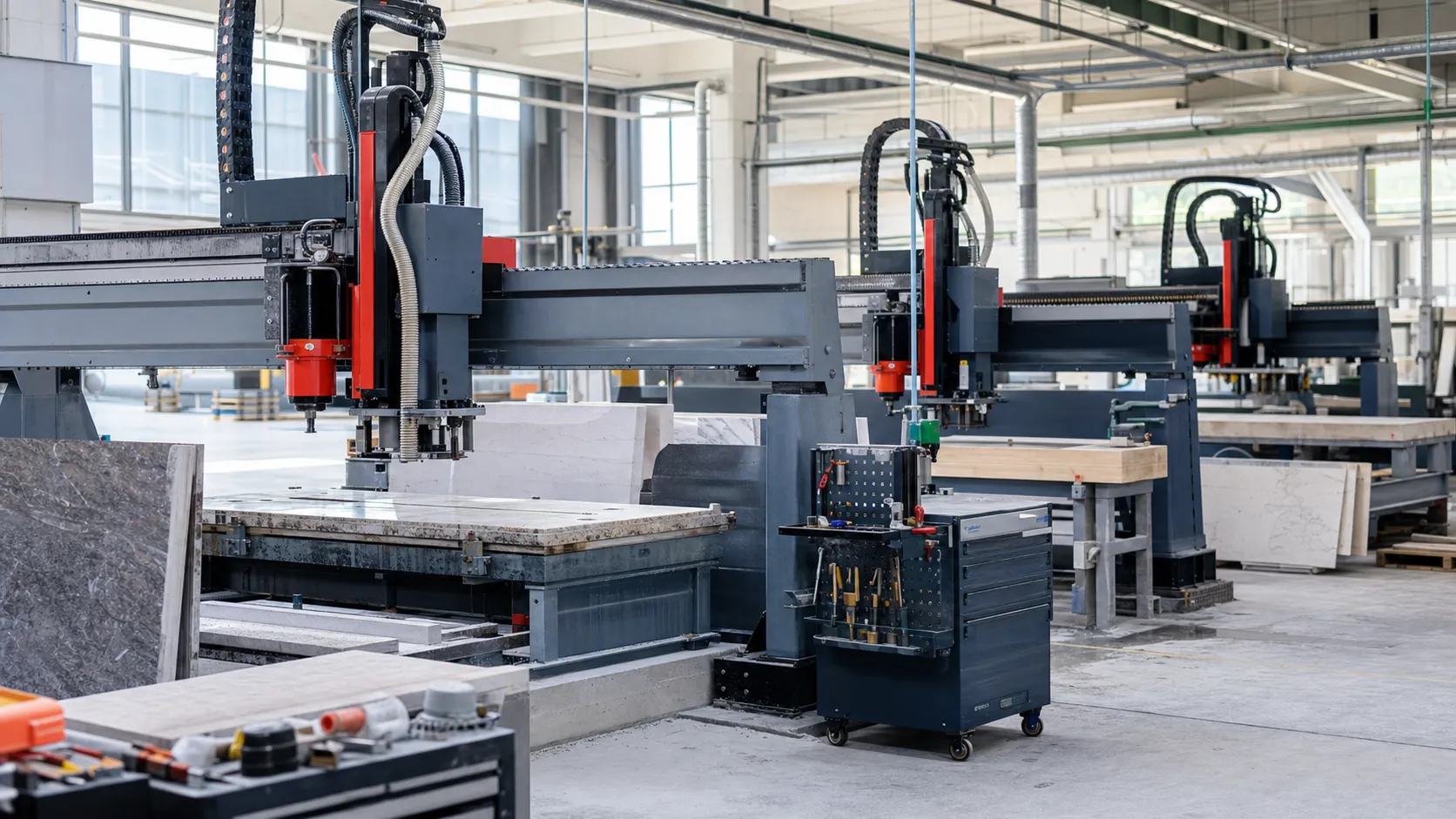
Key Hardware Benchmarks Across Our Lineup
- Heavy-Duty Cast Iron Frame: Every machine in our lineup uses a stress-relieved, thick-walled steel or cast iron gantry setup to eliminate spindle deflection when cutting dense granite or engineered quartz.
- Slurry Protection & Dust Shielding: All axes are fully enclosed with stainless steel guide rails and waterproof bellows. This keeps abrasive stone dust and water runoff away from the precision ball screws.
- Rotary Axis Attachment: The 6090 and 1325 formats can be equipped with a side-mounted or bed-mounted rotary device for full 3D headstone modeling and column turning.
Best CNC Router Stone Industry: Factory Direct OEM Advantages
For American stone countertop fabrication and monument shops, this translates to zero flex, less downtime, and a machine that outlasts standard routers.
Turnkey Customization via OEM/ODM Engineering
Every fabrication shop operates differently. Whether you need a specialized ATC stone CNC router for complex edge polishing or an oversized bed configuration for heavy granite slabs, our in-house engineering team designs to your exact footprint. We modify hardware components, table dimensions, and control interfaces to integrate seamlessly into your current production line.
Rigorous Global Quality Certifications
We do not cut corners on safety or compliance. Every piece of equipment leaving our facility undergoes strict quality control protocols to meet international standards.
- CE & ISO Compliance: Fully certified for structural safety and operational reliability.
- Premium Component Sourcing: Built with high-grade industrial rails, robust shielding, and top-tier electronics.
- Tested Under Load: Every unit undergoes real-world stress testing on hard granite and quartz before packaging.
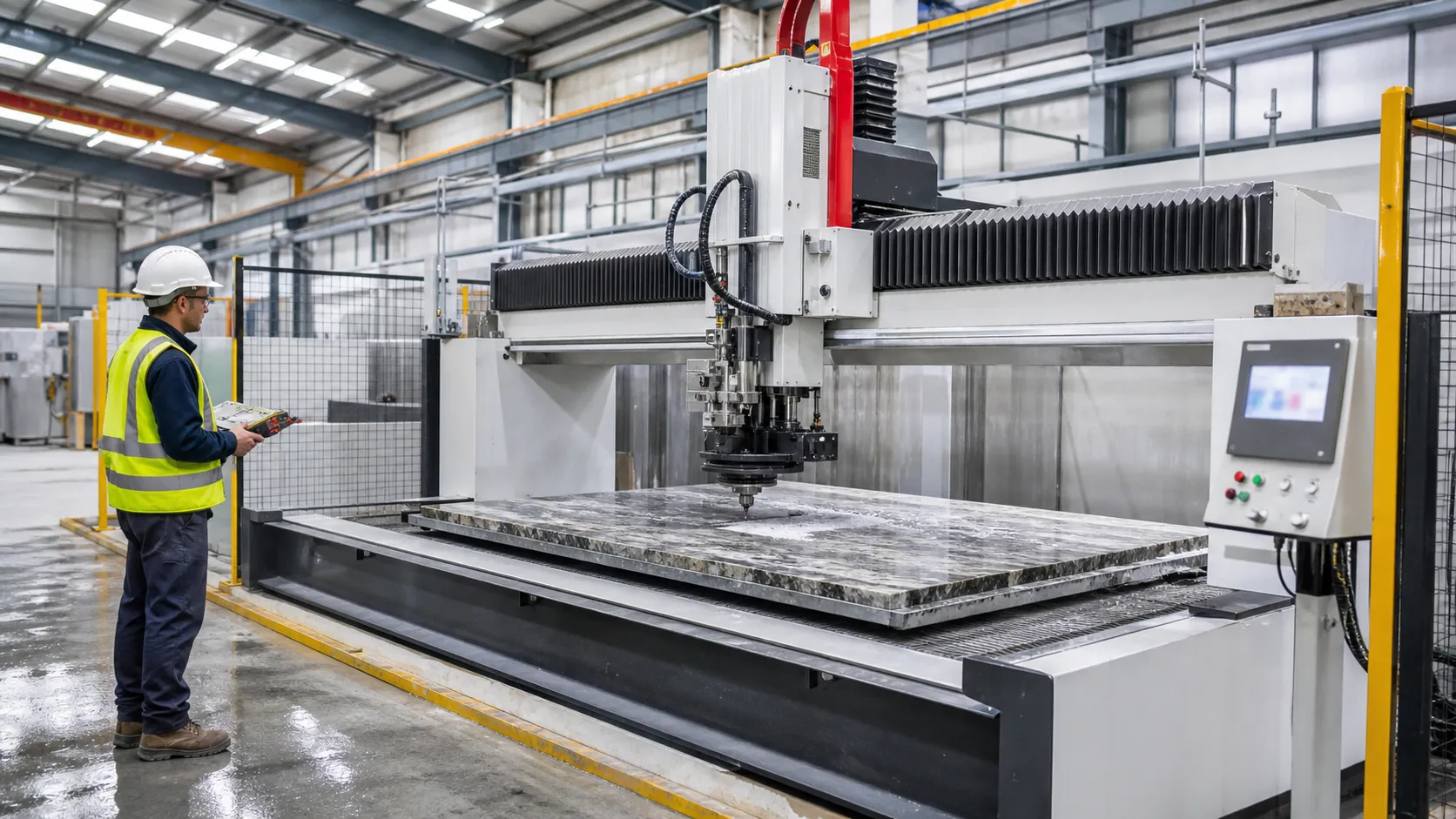
Direct Ex-Factory Pricing & Transparent Capital Investment
Investing in the best cnc router stone industry professionals trust shouldn’t mean paying massive distributor markups. We provide ex-factory direct pricing, allowing you to maximize your equipment budget. By buying directly from us, you get transparent upfront costs, shorter payback periods, and a higher return on investment for your business.
Streamlining Your Purchase: The 5-Step Operational Roadmap
Investing in the best cnc router stone industry professionals trust requires a clear execution plan. The procurement process follows five distinct milestones to get your shop up and running without costly downtime
1. Configuration Selection and Blueprinting
We start by assessing your specific production bottleneck—whether that is high-volume stone countertop fabrication or intricate 3D relief carving. Our engineering team aligns your material needs (like granite or quartz) with the correct frame mass, footprint, and spindle power.
2. Engineering and Factory Floor Production
Once you approve the technical specifications, your machine enters production on our factory floor. This step involves:
- Casting and stress-relieving the heavy-duty cast iron frame.
- Installing precision linear guides and the slurry protection and dust shielding systems.
- Integrating the NC-Studio control system and testing the water-cooled spindle.
3. Rigorous Quality Calibration
Before any machinery leaves our facility, it undergoes intensive load and precision testing. We cut real granite and engineered stone samples to verify dimensional accuracy, tracking speed, and fluid management systems under continuous operational stress.
4. Secure Logistics and Custom Brokerage
We manage the heavy-freight logistics directly from our floor to your US workshop. All components are treated with anti-rust coatings, vacuum-sealed, and packed into reinforced steel-framed crates to withstand ocean freight and local flatbed transit.
5. Installation, Software Integration, and Commissioning
The final step brings the machinery to life on your floor. We guide your team through the physical setup, connect your existing CAD/CAM design software, and calibrate the tooling parameters so you can immediately begin processing premium stone surfaces.
FAQ: Best CNC Router Stone Industry Buying Guide
When you are investing in the best CNC router stone industry shops rely on, you need clear answers to make the right call for your shop. Here are the honest, direct answers to the questions we get asked most on the factory floor.
What is the average lifespan of a water-cooled spindle when cutting granite daily?
For a heavy-duty water-cooled spindle (5.5 kW – 7.5 kW) cutting granite daily, you can expect 3,000 to 5,000 operational hours before needing a bearing replacement, provided you maintain clean water filtration. In a busy stone countertop fabrication shop, this translates to roughly 2 to 3 years of reliable, continuous use.
- To maximize lifespan: Never skip water tank flushes. Granite slurry acts like sandpaper if it recirculates into the cooling system.
Can a standard 3-axis stone router be retrofitted with a rotary axis later on?
Yes. We engineer our standard 3-axis 1325 stone CNC router format with plug-and-play control ports. You can easily add a rotary axis attachment later for 3D relief carving, monument detailing, and complex tombstone or headstone manufacturing.
- Note: Make sure you specify this requirement during your initial order so we can oversize the gantry clearance height to accommodate the rotary chuck diameter down the road.
What CAD/CAM software integrations are recommended for ProMach CNC machinery?
Our ProMach machines run on open-architecture controllers like the NC-Studio control system, giving you complete software flexibility. We recommend the following industry standards:
- Alphacam / ArtCAM: The gold standard for 3D relief carving, line engraving, and complex architectural stone cutting.
- EasySTONE: Ideal for automated stone countertop fabrication, edge polishing, and sink cutouts.
- Type3: Excellent for precision text engraving on marble engraving machine setups and monument work.
How does a sunken bed structure differ from a flatbed with a water tray?
| Feature | Sunken Bed Structure (ProMach Design) | Standard Flatbed with Water Tray |
|---|---|---|
| Rigidity | Built directly into a heavy-duty cast iron frame; lower center of gravity. | Bolt-on tray sits on top of a standard frame. |
| Slurry Management | Deep, sloped recess channels water and stone dust automatically. | Water splashes easily; mud accumulates in tight corners. |
| Loading Safety | Low profile makes loading heavy slabs of granite and quartz safer. | High lip requires lifting stones over the edge, increasing crack risks. |
| Lifespan | Maximum slurry protection and dust shielding for guide rails. | Higher risk of guide rails rusting from standing water spray. |