The right accessories are what bridge the gap between a frustrating, rough-cut prototype and a flawless, retail-ready finish.
Whether you are a hobbyist looking to eliminate tear-out on premium hardwoods or a high-volume shop owner aiming to slash cycle times, this master checklist of upgrades will transform your workflow.
Let's dive right in.
Must Have Accessories for Wood CNC Routing
Starting out with a new CNC machine can be overwhelming. You might be wondering: What tools do I actually need to get clean cuts right away without breaking the bank? Why are my bits snapping, and how do I ensure my projects come out perfectly flat?
We manufacture professional-grade CNC wood routers and components, and we know that your machine is only as good as the tooling attached to it. To get the cleanest cuts and tightest tolerances, you need to start with the right cutting and toolholding foundation.
The Essential Router Bit Starter Kit
A versatile starter kit balances clean surface finishes with efficient chip evacuation. For high-performance wood routing, your shop needs a mix of geometry styles.
- Upcut End Mills: Best for rapid clearing and deep pocketing. They pull chips up and out of the cut, preventing heat buildup.
- Downcut End Mills: Perfect for thin materials and laminates. They push chips downward, leaving a flawless, splinter-free top surface.
- Compression End Mills: The ultimate choice for plywood and nested CNC workholding solutions. They combine upcut and downcut geometries to compress the material, ensuring clean edges on both the top and bottom faces.
- V-Groove Bits: Essential for crisp sign making, chamfering, and detailed carving work.
Spoilboard Surfacing & Flattening Bits
A perfectly flat machine bed is non-negotiable for precise Z-axis depth control. If your spoilboard is uneven, your cut depths will vary across the workpiece.
| Bit Type | Best Used For | Key Advantage |
|---|---|---|
| Indexable Carbide Flattening Bit | Heavy-duty surfacing and regular board maintenance | Rotatable carbide inserts mean you only replace the teeth, not the whole tool. |
| Solid Carbide Flycutter | Quick skim passes on smaller CNC beds | Provides a massive cutting diameter for fast leveling cycles. |
Pro Tip: Plan to use your spoil board flattening bit to resurface your bed every time it gets heavily scarred or after major climate shifts, as MDF swells with humidity.
High-Precision ER Collets and Reducing Adapters
Your spindle upgrade kit needs a high-precision gripping system to eliminate runout. Runout causes tool chatter, poor surface finishes, and premature bit breakage.
- Precision ER Collets: We recommend using dedicated ER20 or ER25 collets matched precisely to your tool shank size (like 1/4" or 1/2"). This ensures 360-degree clamping pressure.
- Collet Reducing Adapter: If you need to run a smaller 1/8" detail bit but only have a 1/4" collet on hand, a premium collet reducing adapter bridges the gap safely without sacrificing accuracy.
Investing in high-quality toolholding components protects your spindle bearings and keeps your CNC router bits running true for years to any global market standards.
Next-Level Workholding Solutions
If your lumber shifts even a millimeter during a cut, your project is scrap. To get the most out of your machinery, you need robust CNC workholding solutions that keep parts locked perfectly flat without getting in the way of your router bits.
For high-production shops looking to streamline their workflow, upgrading to advanced woodworking CNC automation solutions cuts down setup times drastically and keeps your hands safe.
High-Volume Vacuum Hold-Down Systems
A high-volume vacuum hold-down system is the ultimate choice for rapid part processing. By pulling consistent atmospheric pressure across the entire surface of the sheet, it eliminates the need for screws or manual clamps.
- Best For: Nested sheet goods, large cabinet parts, and thin plywood.
- Key Advantage: Allows for full-perimeter cutting without obstruction.
- Pro Tip: Pair with a dedicated vacuum pump that delivers at least 15–20 Hg (inches of mercury) to ensure dense hardwoods don't pop loose under heavy lateral cutting forces.
Low-Profile Mechanical Clamp Sets
When a vacuum grid isn't practical—like when carving thick live-edge slabs or small custom blocks—a heavy-duty workholding clamp set is your best backup. Standard toggle clamps are often too tall, risking a catastrophic collision with your gantry or spindle.
- Low-Profile Cam Clamps: Apply aggressive side pressure to wedge the wood in place from the edges.
- Toe Clamps: Grip the bottom lip of the material, keeping the top surface 100% clear for surfacing operations.
- T-Track Accessories: Use anodized aluminum tracks embedded directly into your deck for infinitely adjustable clamping positions.
Spoilboard Material & Gasket Upgrades
Your vacuum or clamping setup is only as good as your deck. Standard MDF works for basic setups, but premium must have accessories for wood cnc routing include high-density MDF (LDF or Trupan) paired with closed-cell foam gasketing.
| Upgrade Type | Best Used For | Why It Matters |
|---|---|---|
| LDF / Trupan Spoilboard | Vacuum tables | Highly porous; allows maximum airflow to pull parts down securely. |
| Closed-Cell Rubber Gaskets | Dedicated vacuum pods | Seals the perimeter perfectly, preventing vacuum leaks on warped lumber. |
| T-Slot Grid Plugs | Mechanical clamping tables | Seals off unused zones to maintain maximum suction where you need it most. |
Dust Management and Shop Safety
Wood CNC routing creates a massive amount of fine dust and chips in a very short time. Without the right gear, this airborne debris ruins your cuts, wears down your linear rails, and poses a serious health risk. Keeping your shop clean isn't just about housekeeping—it is about protecting your machine investment and your lungs.
High-Efficiency CNC Dust Boots
A high-efficiency dust boot collection system is your first line of defense. The dust boot mounts directly to your spindle, surrounding the router bit to trap chips right at the cutting source before they fly across the shop.
- Split-Design Boots: Look for magnetic, quick-release split designs that let you change bits without removing the entire hose assembly.
- Brush Length: Choose a brush that matches your material thickness to maintain a tight seal against the wood surface without restricting machine movement.
- Clear Visibility: High-quality transparent acrylic boots let you monitor the tool path and chip evacuation in real time.
Dedicated Dust Collection & Air Filtration
Standard shop vacs quickly choke on the sheer volume of waste generated by a wood CNC router. You need a dedicated high-volume dust collector paired with proper ambient air filtration to handle the workload.
- High CFM Dust Collectors: Use a collector rated for at least 1–2 HP to provide enough continuous suction (CFM) through your flexible ducting.
- Cyclone Separators: Adding a cyclone pre-separator drops heavy wood chips into a drum before they ever reach your main filter, preventing clogs and maintaining peak suction.
- 1-Micron Canister Filters: Upgrade from standard cloth bags to pleated canister filters to trap invisible, hazardous micro-dust.
- Ambient Air Cleaners: Hang an overhead air filtration unit to constantly recycle the shop air, capturing any stray fine dust that escapes the main boot.
If you are looking to upgrade your machine setup with heavy-duty components, check out our durable CNC spare parts designed to keep your production running smoothly and safely.
Automated Setup and Calibration Tools for Wood CNC Routing
Manual zeroing is a massive time-waster and the quickest way to ruin a workpiece. To get the most out of your setup, automating your calibration process is one of the best upgrades you can make. It guarantees repeatable accuracy and saves your bits from accidental crashes.
3-Axis Touch Probes (XYZ Zeroing)
A 3-axis touch probe completely changes how you find your material edges. Instead of using the paper trick to manually eyeball your X, Y, and Z axes, you position the probe on the corner of your stock. The machine runs a quick routine, senses the electrical contact, and sets the perfect work coordinate system (WCS) in seconds. It is essential for complex, multi-sided flips and precision joinery.
Tool Length Sensors & Z-Probes
When running jobs that require multiple cutting tools—like switching from a roughing clearance end mill to a fine v-bit—keeping a consistent Z-axis zero is critical.
- Z-Probes: Quick, manual-placement pucks used to find the top of the material.
- Tool Length Sensors: Fixed-position sensors mounted to your machine bed. After every tool change, the spindle taps the sensor to calculate the new tool length automatically, keeping your cutting depths perfectly consistent.
Dial Indicators & Tramming Systems
If your spindle isn't perfectly perpendicular to the spoilboard, your flat pockets will have ridges and your cuts will be tapered. A dial indicator tramming setup allows you to measure microscopic tilts in your spindle mount. By sweeping a dial indicator across the bed, you can precisely shim or adjust your machine axis until it is perfectly square, eliminating tooling marks and extending the life of your wood CNC routing accessories.
Power and Versatility Upgrades for Wood CNC Routing
Upgrading your power and cutting capabilities turns a standard setup into a high-production workhorse. As a dedicated CNC wood routers manufacturer, we know that upgrading your drive and cutting components directly impacts your shop's throughput and the variety of jobs you can take on.
High-Torque Spindle Upgrades: Air vs. Water Cooled
Ditching a standard router for a dedicated spindle upgrade kit improves edge finish, cuts down on noise, and allows for continuous operation. When selecting a high-torque spindle, the choice comes down to your shop environment and material mix.
| Feature | Air-Cooled Spindles | Water-Cooled Spindles |
|---|---|---|
| Installation | Simple, plug-and-play setup | Requires radiator, pump, and tubing |
| Maintenance | Low; requires periodic dust clearing | Moderate; requires coolant management |
| Noise Level | Louder at high RPMs | Extremely quiet operation |
| Best For | Dusty environments, colder shops | Heavy duty production, quiet workspaces |
Air-cooled spindles rely on fan blades to push air across the unit, making them highly reliable in dusty woodworking environments where liquid maintenance is a hassle. Water-cooled spindles maintain a lower temperature during long 3D carving sessions, preserving bearing life and keeping shop noise to an absolute minimum.
Add-On Laser Modules
Integrating a solid-state laser module onto your CNC gantry adds branding, detailed engraving, and fine cutting capabilities to your workflow without requiring a second machine.
- Hybrid Functionality: Toggle between heavy chip evacuation with router bits and fine vector etching using the laser.
- Detailed Branding: Easily burn logos, serial numbers, and intricate line art directly onto wooden components before they leave the spoilboard.
- Material Variety: While excellent for wood, these modules also allow you to mark materials that traditional carving bits struggle with. For shops looking to expand completely into dedicated laser fabrication, integrating a specialized laser cutting machine into your production line offers the ultimate speed and precision for non-wood mediums.
Post-Processing & Maintenance Essentials for Wood CNC Routing
Getting a clean cut on your wood CNC router is only half the battle. What happens after the machine stops running determines the final quality of your project. Having the right cleanup tools and keeping your machine running smoothly prevents costly downtime and ruined workpieces.
Clean-Up Tools: Pull Saws and Tab Cleaners
When cutting out nested parts, you will inevitably use tabs to keep pieces from flying off the table. Removing these parts efficiently requires specialized manual tools.
- Japanese Pull Saws: A flush-cut pull saw is the best tool for slicing through holding tabs. The flexible blade bends flat against the workpiece, allowing you to cut the tab away without marring the wood surface.
- Tab Cleaners & Router Planes: Once the part is free, small handheld laminate trimmers or manual edge deburring tools clean up the remaining nub quickly.
- Precision Chisels: A sharp, flat chisel helps square up inside corners where a round CNC router bit naturally leaves a radius.
Machine Maintenance Kit
A CNC router is a major investment, and dust is its biggest enemy. Wood shavings and fine dust mix with lubricants, creating a gritty paste that ruins bearings and lead screws. Every shop needs a dedicated maintenance kit ready by the machine.
| Maintenance Item | Purpose | Frequency |
|---|---|---|
| Dry PTFE Lubricant | Lubricates linear rails and ball screws without attracting wood dust. | Weekly |
| Collet Cleaning Brushes | Removes pitch and resin buildup inside the spindle taper and collets. | Every bit change |
| Calibrated Dial Indicators | Used for dial indicator tramming to keep the spindle perfectly square. | Monthly |
| Precision Digital Calipers | Checks part accuracy to catch axis drifting or loose belts early. | Daily |
Regularly cleaning your components ensures your CNC machining center maintains its tight tolerances. Skipping basic maintenance leads to premature wear on your spindle upgrade kit, sloppy cuts, and eventually, ruined wood stock. Keep your rails wiped down, your collets degreased, and your sensors clear of stray chips.
FAQs
What accessories do I need first for a wood CNC router?
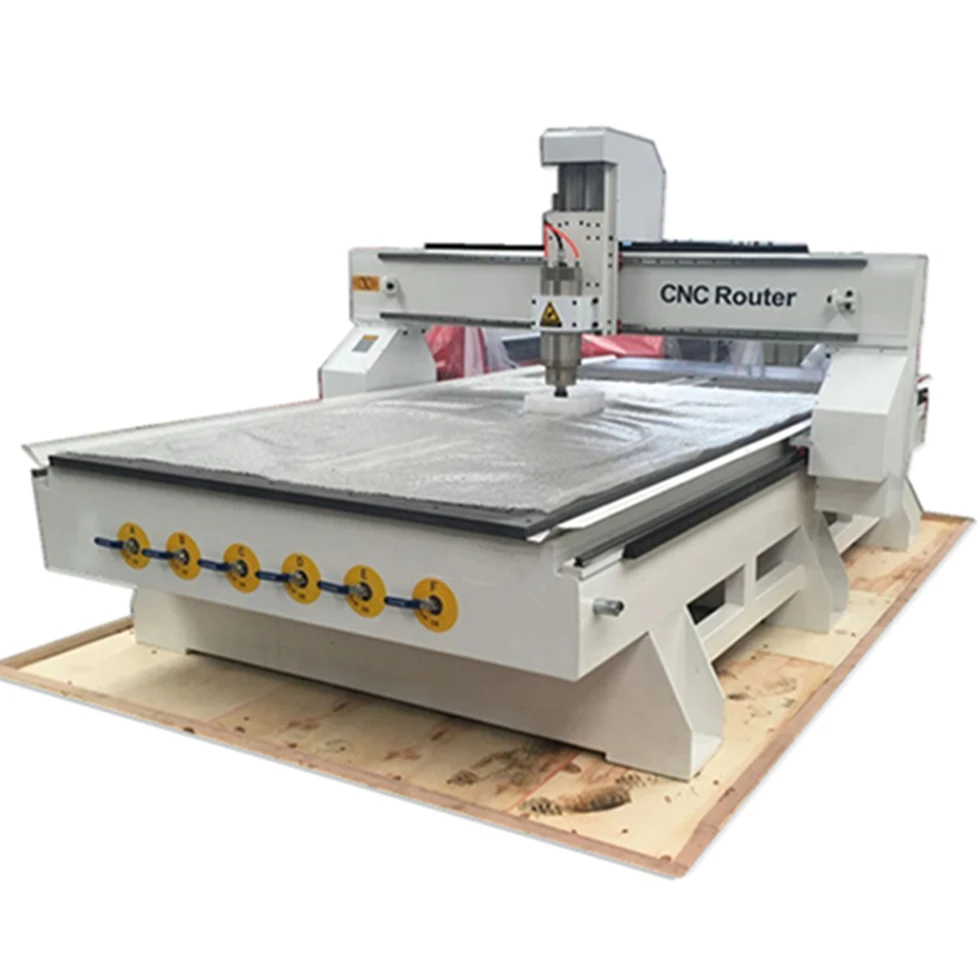
When setting up a machine like our industrial-grade 1325 CNC wood router, you should focus on the essentials first. Prioritize a reliable workholding clamp set, a basic starter pack of CNC router bits, a high-efficiency dust boot collection setup, and a tool length sensor to quickly set your Z-axis zero point.
Can I use a standard shop vac for CNC dust collection?
You can use a shop vac for smaller, hobbyist desktop machines, but it is not ideal for production-level wood routing. Wood CNC routing generates a massive volume of fine dust and chips that will quickly clog a standard shop vac. For clean operations and optimal tool life, a dedicated dust boot collection system hooked up to a high-volume dust collector is highly recommended.
Why is my CNC router bit burning the wood?
Wood burning is usually caused by excessive friction when the heat cannot escape the cut. The most common reasons include:
- Feed rate is too slow: The bit stays in one place for too long, rubbing instead of cutting.
- Spindle speed (RPM) is too high: Generating excess heat.
- Dull cutting tools: Dragging through the material rather than slicing it.
- Poor chip evacuation: Recutting sawdust trapped in the groove.
How often should I flatten my CNC spoilboard?
You should flatten your spoilboard whenever the surface becomes uneven, heavily scarred, or after installing a new sheet of MDF. For heavy commercial users operating our versatile 6090 CNC wood router, running a spoil board flattening bit once every few weeks ensures the absolute depth accuracy needed for high-quality 3D carving and through-cutting.
What is the difference between upcut and downcut CNC bits?
Choosing the right direction for chip evacuation changes your edge finish entirely:
| Bit Type | Chip Evacuation Direction | Top Edge Quality | Bottom Edge Quality | Best Used For |
|---|---|---|---|---|
| Upcut Spiral | Upward (pulls chips out) | Can cause fraying/chipping | Clean edge | Deep grooving, rapid material removal |
| Downcut Spiral | Downward (pushes chips down) | Perfectly clean edge | Can cause fraying | Thin materials, shallow pocketing, veneers |
| Compression End Mills | Pulls up from bottom, pushes down from top | Perfectly clean edge | Perfectly clean edge | Plywood, MDF, laminated sheet goods |